
Iran's Revolution
The Islamic regime may fall and it will have global consequences

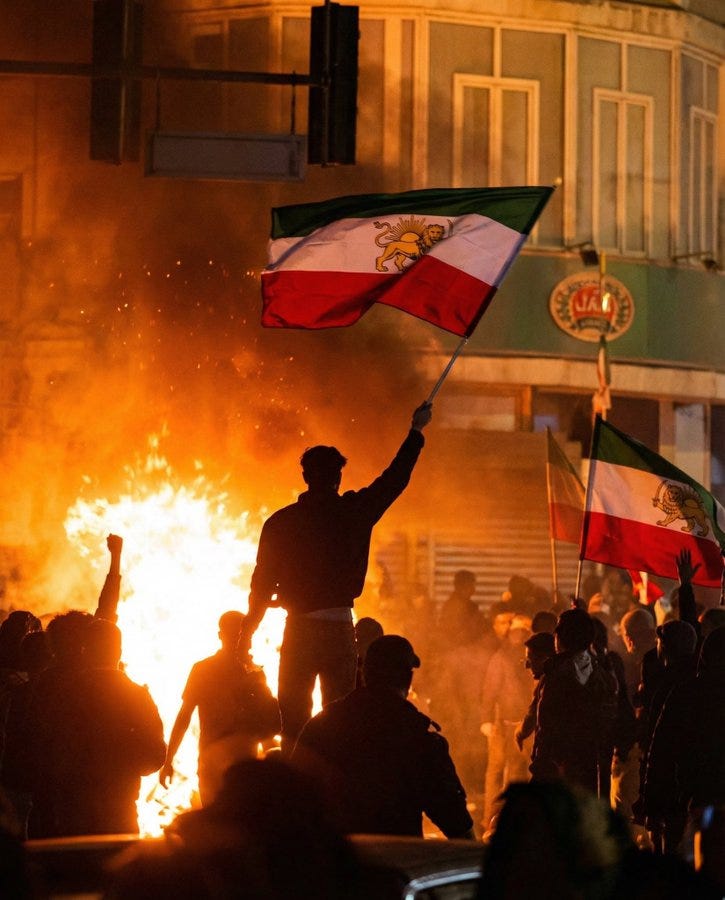
As of this writing the internet has been shut down, communications are - safe for Starlink here and there - not working and even electricity has been shut off in major cities. Iran’s mullah regime appears to be on its last legs, but that points to the dangers ahead: desperation creates desperate moves and who knows how many innocent Iranian citizens have been murdered over the past week. This is Tiananmen on steroids, firing into unarmed crowds on multiple locations across the country. The Khamenei regime rests on the power of its security apparatus: the police and army, but more crucially the Islamic Revolutionary Guard Corps (IRGC) and the Basiji militia. The latter two are the most ruthless and they have a stake in the current order. They are the last ones to lay down arms; joining the other side is not an option, nor are there enough planes to carry them all to Moscow.
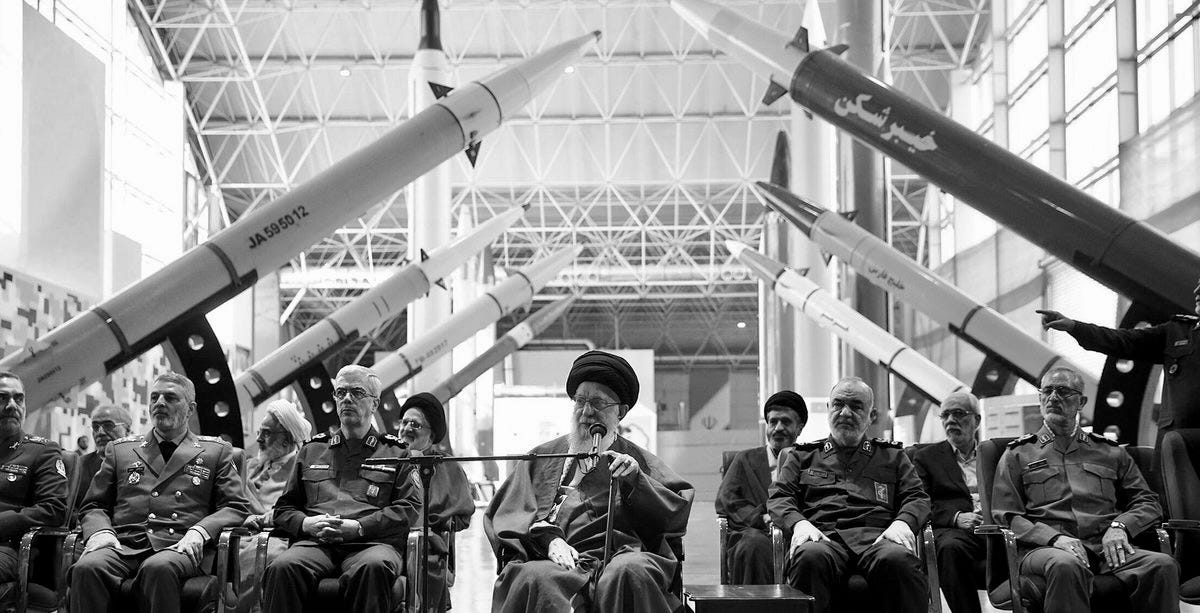
This is monumental and history in the making which is why it is all the more baffling that many Western media were slow to pick up on this as the revolution gained momentum over the past two weeks. Initially billed as ‘protests’ against inflation and economic hardships, anyone familiar with Iran’s recent history will know these were merely accelerants. The discontent in Iran runs very deep and earlier attempts to shake off the blood-drenched misogynist regime all ended in violent crackdowns on the Iranian people. It was hard for many to recognize and report on this as it would mean at least some acknowledgement that Donald Trump was right (departing from the nuclear deal, applying sanctions, attacking the nuclear sites) as was that other ‘bogeyman’ of the past few years, Benjamin Nethanyahu.
Iran’s revolution was cheered in 1979 as a people-led and anti-colonial force that deposed the US-backed Shah. It was soon forgotten that it was a Socialist-Islamist alliance that took over and installed ayatollah Khomeini who proceed to literally snuff out his progressive partners in order to solidify the Islamic State. In newsrooms that were pre-occupied with Gaza for the past two years it was hard to shift gears and actually see how American and Israeli moves actually were helping to liberate a brutal Islamist dictatorship.
Yet any sane journalist could have quickly spotted the deeper story here. Much like Nicolae Ceaușescu’s offer to raise minimum wages moments before helicopters evacuated him to - as it turned out - his execution, was the Iranian’s regime offer of a stipend of $7 for each Iranian. Too little, too late. What is left is branding each protesting Iranian on the streets as an accomplice of foreign powers, US and Israel, sufficient grounds to start shooting. A just released yet unverified report mentions over 2,000 dead, including children, in the last 48 hours.
The regime is weakened on many levels. Not only did its international adventures fail miserably, domestically the economic bite and a serious water crisis further undermined its legitimacy. And what has been underestimated so far is the ultimate will of its people, in particular Iran’s young. Fearless and determined to see an end to the powers that subjugated their freedoms, intimidated its women and frustrated its economic opportunity, these are the forces that are now ready to end it all with whatever means they have.
It brings up the question as to what is next and if America will intervene. It should be remembered that during the 2009 Green Uprising the Obama administration stood aside in order to avoid any success being seen as US intervention. It was up to the Iranian people and that approach dovetailed with the policy of working with and appeasing the regime, in particular to secure a nuclear treaty (which came into being in 2015). Simply put, this approach legitimized and emboldened an evil regime that quashed the will of its people while rolling out and aggressive map of proxy wars in the Middle East. Stability without asking the hard questions created a regional monster, something Trump recognized. So his administration has turned this equation upside down, but the real question now is if it is indeed willing to go one step further and directly support the current revolution. The US has no shortage of intelligence to target specific regime strongholds (IRGC, Basiji) to ensure it could fall, yet it is a risky operation. It is a lot harder than lifting Maduro and his wife out of their palace. Based on Trump’s statements so far something may happen, but no one knows what.
Now if the regime falls the question will also be what leaders will emerge to take over the power structures that are now in play. Reza Pahlavi is the frontrunner and it seems he is now much better organized than before and indeed seen as the legitimate candidate to unify the various opposition groups under one banner. If this happens his role will be decidedly different from his late father’s, it will be one of a constitutional monarch who can lead and inspire, but who will have to share power and pave the way to a functioning democracy.
Now, I will be getting too much ahead of myself to describe what a liberated Iran will mean for the Middle East and the world, but here are a few important things to consider here. First it will shake up and reduce the tensions between Sunni Muslims and Shi’a Muslims. That means that large Sunni nations like Saudi Arabia can refocus their attention on other problem areas, direct conflict with Iran will be less likely than at any time in the past five decades. There is also a big bloody nose and a loss of influence for the other two pillars of world power: Russia (arms partner) and China (who has been buying the bulk of Iran’s oil supplies). It will also cripple Iran’s violent proxies like Hezbollah, the Houthis in Yemen and indeed Hamas. It will validate what Nethanyahu has been arguing for his entire time in office and he will absolutely use it as the platform to run on in this year’s Israeli elections which he is in a very good position to win now.
A new flourishing and peaceful Middle East with open borders and trade? Yes. Caveat one is that an emerging power is waiting in the wings to take the mantle of expansive adventures in the Middle East powered by Islamism: Turkey. Caveat two, the more important one, is that anything can happen over the coming days including a defeat of the people’s rebellion and rivers of blood. Let’s hope it will not come to that and that the people will finally win.
I will leave you with the lone guy who today changed the flag on Iran’s embassy in London:
I hope this leads to a freer Iran, one where the rule of law is observed and the people have a real role in shaping the government. I fear this will not necessarily happen. It would be good to understand the ways in which these revolutions can have good long term outcomes. The US is one of the few countries where this worked out, and even there, they had a bloody war with England followed a few decades later by a brutal Civil War. The French went through a series of revolutions and coups, plus an enemy occupation, to get to the Fifth Republic. The more evolutionary approach of the British colonies (India, Canada, Australia, New Zealand, etc.) seems to be a more successful path, if not always successful or without its own pain. Let's hope this Iranian revolution occurs and takes Iran forward.
Long live the Iranian people! I am holding my breath and praying for their success in remiving their eveil regime.
I see a different logic playing when it comes to Netanyahu: his entire career was staked on defending Israel against the existential danger posed to Israel by Iran. Once the islamic regime is removed, there is no way to justify him remainimg in power.
I am concerned that the fall of the Iranian regime will make Saudi Arabia and other Suni arab countries align with Turkey against, you guessed it, Israel. Having Netanyahu as Israel PM will then help them leave Israel isolated. Whatbare your thoughts on that?